Monday, September 12, 2011

Longing and Satisfaction

   I sit at this canvas for most the hours of my life, and I miss little of the world outside. Occasionally, I break to visit a store or check a mailing. News is everywhere, and to these eyes nothing much has changed, save that I'm more peaceful with it all. Living and seeing as I have, so many things work out, not much bothers me. It's been many years since I've seen any problem that I couldn't reference an old experience to. Even then, if what worked out before did, then so would this.
  There's something about these brushes, or the act of moving paint. Without words, there are answers in the mere act of taking this action, or any. Someone once told me, "Those canvases can't love you!" in anger. Neither could they, it turns out, but being loved has never been a goal I found worth seeking. It works better to simply love. That I can do often with a brush, but in many other ways as well. My life is full of love.
  I am content with each moment with the gift of yearning for the next. I've heard it called, "Divine Dissatisfaction," that state of gratitude where I know I can be more, so I love. I paint. I strive without struggle to the next level of contentment.
tina jones
"In Blue"
8x8"
Oil on Canvas

Saturday, September 3, 2011

Artists on the Autism Spectrum: Improving Gallery Accessibility

   I was very impressed recently when my state of Kentucky published an article for improving the accessibility to galleries for people with disabilities. Autistic viewers were mentioned, and I welled up with pride at living in a state that shows active awareness for it's people!
http://creativecommonwealth.ky.gov/
   I had to write to tell them, and I asked if they had ideas for people on the Autism Spectrum who were Artists themselves, as well as offering to collaborate on some ideas I had. They said "The Arts council would love to have your insights."
  I took ideas I had and went to the people who know best. I went to other artists with Autism, and asked what problems they'd encountered, and what ideas they had that might help. I also went to my daughter who came up with some great insights, as well as numerous people who are not Autistic, yet have some of the same issues with sensory problems. I was amazed at how willing people were to help each other!
  To begin, the two main inhibitors to artists with Autism are Sensory Issues and difficulty in socializing. Galleries need to entertain patrons, and it's beneficial to them that artists and patrons socialize. Galleries are a business, and socializing means sales. As Temple Grandin has indicated, we on the Spectrum are not good at "selling ourselves." We must sell our work, our talents, expertise and our portfolios. This is the problem I hope to build a bridge of understanding over, and hopefully help to facilitate compromise that will be beneficial to artists on the Autism Spectrum, Patrons of the arts, and Galleries.
 Following are two lists. One is ideas that galleries might be able to do to improve accessibility, facilitate interaction between artists with Autism/Asperger's and Patrons. The second is some things artist's with Autism may be able to do themselves to make the experience simpler and more enjoyable, beneficial. These are only ideas. What works for one may need adjusting for another, but it's a place to begin.


 To Galleries:
     Sensory Issues: Things like a lot of noise can be enough to cause a person with Autism to lose their ability to communicate, and communication means sales. It can cause us to have to leave to regain our composure. What happens with me, personally is that when music is loud, I cannot focus on what you or Patrons are saying. I physically feel the loudness, and it's overwhelming. At the very least, I'd have to walk out. I might be shaken to tears. Those who are more sensitive than I could run, cover their ears, and scream. We are more sensitive to sound than the average person. For comparison, it might be like you standing by a 6ft speaker at a rock concert while trying to have a gentle conversation. It's not possible.
    1-Consider asking the artist what music they might prefer (I realize this is there for the Patrons, so giving the artist some choice in input might help. I, for instance, would be much more comfortable with a soft string quartet or a gentle classical CD than a rock band or country music band.)

    2- Consider having no music

       Social Issues: Most often, it's been suggested that I mingle and talk to Patrons. This is exceedingly difficult for me and impossible for some others. I and others have trouble conversing, knowing when to speak or where we belong. We can get lost if we don't know exactly what to do. Some things you might do to make this easier:

  1- A designated place for the artist with Autism. (We can leave this, but have it to return to.)Think in terms of a book signing. I need to know where I'm supposed to be/ have a place to belong. If a table and chair were set up, where others could approach me one at a time, I'd be much more comfortable and have an easier time talking to Patrons. I'd suggest this be set at the furthest possible distance from the loudest area if there is music as possible.

  2-  Consider using our written materials to aid in communication. The artist may only be able to make "appearances." If the gathering is 2 hours long, some of us may only be able to be there for 10 minutes, leave then return for 10 more. We may be able to provide you with written information about our work. Consider that a worker might field some questions for us. We may also have an assistant with us that can help with this. (see 3)

  3- We may be unable to speak. Some of us cannot at all, others like me can go mute during very stressful situations. Consider that we may have to bring a person to speak on our behalf, or at least aid us in conversation with Patrons.

  4- Short speeches or our writing read by another: Where mingling isn't possible for some of us, some may be able to do a short monologue about our work. We may even be able to answer a few questions from the crowd. While we can be as nervous as anyone in a *speech* situation, it is far easier than mingling. (The Lexington Art League at the Loudon House has an "Gallery Talk" once a month that would be a great model for this. There, the artist talks to a group of artists. This could be used for the artist to also talk to a group of Patrons at the beginning of a show, or at some point during. A quiet area would need be extablished for this.)

  5- We could benefit greatly from a private "cool down" area, as mentioned in the article (link above)that inspired me. If given this, we could take a break, relax and come back fresh to interact.

  6- Online communication: You may work with artist who simply cannot be present for shows. Often, non verbal artists can type and communicate beautifully in online "chat" situations. Consider that one or even a few computers might be set up at a show, so that Patrons could interact with the artist. (Patrons love an eccentric artist, and a good story to tell of the artwork they purchased and how they got to know the artist! They'll eat it up!)

   7-Video and photos might be provided by the artist where possible. If the situation is such that the artist is verbal, but cannot attend a public show, consider that the artist might make a short video discussing their work and provide it to you. It might be shown to patrons as part of the display.


  To my fellow Artists with Autism Spectrum Disorder:
   As you've read above, I've only covered a few things. Other sensory problems like various smells from perfumes, foods that may be served, people that may bump into us, talk too loud...all of these things are causes for potential melt-downs or shutdowns. Here are some of the ideas I've gathered from my experience and from others on what we can do to make the experience more pleasant. (Those who may be going to assist the artist, can help be sure these or some of these are available.)

   Sensory Issues:
  
1- Eat about an hour before the show. Nervousness can do terrible things to our stomachs, and many of us have food allergies. Best to leave the snack table to the Patrons.

2-Bring or get water. A dry mouth is not good for talking. Bring lip moisturizer as well. Anxiety can rob the mouth of much needed moisture.

3- Keep a comfort object with you. Mine is a kneaded eraser that I can roll and squeeze. Anything that gives you comfort and a sense of familiarity will do. (I never worry about what others think. They expect artists to be a little "eccentric" anyway, and I can even have some fun with it. The point is to take care of me first, then I can be there for them.)

4- Never wear new clothes, rather wear what is clean, and comfortable to you. Look nice, but don't over do with things that are going to cause discomfort. Itching, tugging at uncomfortable fabric or wrestling new shoes is going to make it all more stressful. Be true to you, and don't try to look or act whatever you may think "normal" is. Just wear what you like, and feel good in.

5- Consider long sleeves or a jacket/sweater that you can remove if need be. Like many I have touch sensory issues. NT's love to touch my arm when talking. Long sleeves help buffer this, so I don't feel imposed on or invaded suddenly. I'd also suggest a pair of light gloves if hand shaking is a problem. Remember, you can opt not to shake hands too. Have something in your hands like a bottle of water in one hand and painting in the other, and no one is going to try to shake your hand.

6- Lights: Gallery lights are often low key, and fortunately aimed at paintings rather than us. Still, if they are an issue of pain or discomfort, consider wearing light sunglasses. It's a small buffer, but it often helps me in stores.

7- If you're someone who wears hats, these may help buffer some of the noise and sensations around you to help you focus on the patrons.

 8- Be realistic about how much time you can tolerate being around people. Never say to yourself, "Well I know I can do ten minutes, but I'm sure I can push it to twenty or an hour." Do your ten, take a break and do ten more. If this is repeated, you may be able to stay much longer than you think. If you are only able to do a few minutes, then you have succeeded. If all you can do is send the work, you have succeeded. Be realistic about the expectations you put on yourself, and do not push. Consider what you'd ask an Autistic friend to try, and only go that far. Be as good to you as you naturally are to others.


   Social Issues/Communication:

  1- Have someone who knows you and your work go with you. This person can help with questions, give out information, and help you in a panic situation.

  2- Go to the gallery before the show, even days before. Note where exits are, and where you might go to get away from the crowd for a time if need be. Spot the restrooms and the water. Ask questions. Consider going to a show at this gallery before your show. See how things go, watch and listen to what the artist says and does. See if you might implement some of these ideas.

 3- Make a list of all of your works, and write a little bit about each one, size, price, what medium you used. Write a short paragraph, even two or three sentences about each work. These might be posted beside the work. Also, when a Patron asks you about that work, you can speak a little, then hand them a copy of this note just for them to keep and hold. This can make the experience personal to them. (and they like that) Have business cards: Simply having your contact information written down to hand your Patron can help.

 4- Write or get help writing a paragraph or two, but keep it to a page, about your art. If there is a theme in your show, write it down, and make sure the gallery has a copy of it well before the show. It will help them in promotions. I'll include a list of questions commonly asked of me by Patrons, and my own answers. This may help you form a *script* of what to say in these often awkward situations.

5- Consider an Artistic Autistic duo. Think of times when you had someone to look after. I've felt more confident in those times, so having shows with an other person with Autism my be highly beneficial. Consider group shows as well.

6- It's easier to cheer on another artist. Many of us feel very uncomfortable chatting up our own work (it feels fake, and the work should stand for itself, right?), but we can be champion's for one another, often speaking with much more ease.

7- Consider making attainable goals for communication. If you are verbal, a goal might be to say, "Hi." to three people. You can say, 'Hi" to more, but make a goal plan. This way, we know what to do from the time we walk in the door. ie. I belong at this table. I can go anywhere, but that's my anchor/safe spot, I need to say, "Hi" to three people. These will be small goals for others, but they can be big for us.

8- Establish a panic signal for the person you have assisting you. It can be a simple word or a tug on your own ear. Anything that you and they establish means, "Get me out of here!" or "I need help." Make sure both of you understand this. This person may need to play "linebacker" to get you through the crowd and out to a place to decompress.

9- keep a note pad with you to write down any ideas you may have for a better experience at the next show, questions that you got asked that weren't on your list, etc.

10- Provide the gallery some photos. Photos are hard. Consider taking a few yourself, and providing those to the gallery for their promotions. If the concept of even taking a photo yourself is too much, say so. If you are unable to attend a show and can speak, consider making a short video of yourself talking about your work. Offer this to the gallery to show Patrons.

11- Eye Contact: It's up to you, but Patrons do like it in small bits, no staring. Here is what I do. Eye contact has always been extremely hard for me, but I can use what I have. I'm an artist! I mentally *paint* people while they talk to me. I look at their eyes, then their forehead, their hair, then their chin, nose, back to the eyes. It's my nature to focus if anything on their mouths to try to lip read what doesn't get through to my ears, but I try to move all over the face. I think in terms of colors I might use, or shadows and light. People are really quite beautiful, and I find they warm up to the attention. If they catch me, I simply tell them the truth. "I think the light on your hair is beautiful." or "I was noticing how the shadow lies against your jaw." or simply, "I was mentally painting you." They can be very flattered by this. Be ready to hand them a business card. I've gotten several commissions by accident this way.

12- Listen: The world is full of people who have never had anyone truly listen. Patrons will often ask you a question, get an answer, then they want to talk a while. This is great news for someone like me who can go mute! I can give them a listening ear. No pressure on me to talk, and I can learn things like what kind of art appeals, what about my work touched them, and what I may need to do more of next time. You can even ask them questions:  "What kind of art do you usually like?" "Have you ever tried drawing/painting?" Patrons often want a personal connection with us, and nothing makes this easier than simply listening. If there is a break in their words, nod, say, "oh," "wow," "that's interesting," etc.

      I offer a heartfelt , Thank you to my daughter, Eve Kotter who helps me keep things simple, and to the wonderful people at "Artists and Autism" They put a lot into helping me gather ideas to help us All. Their Facebook page is here. They are of immense support to many artists of all ages on the Autism Spectrum,
http://www.facebook.com/ArtistsandAutism

Lastly, here is a list of common questions I'm asked. You may want to keep them, and write your own answers down for when Patrons ask.

1-How long have you been painting? Many of us, have always. You can state your age if you like. It will be true, but they'll think it's humor, and a smile from them is good business. You can also say how long you've been painting/drawing/sculpting, etc. in this particular way. If you started a year ago, say so. They'll be impressed.)

2-What medium do you use? Oil, Acrylic, Watercolor, Ink, Clay, Fabric, etc,,
Are you self taught or did you take lessons? (It may be for some of us that it's built in.  We just do this, no lessons, no self taught, but "self taught" is clear and understandable to others.)

3-What inspires/influences you? (mom, dad, Picasso, nature, etc?)

4-What are you trying to say/communicate with this work?( Tough one for me. I'm usually communicating some technique, but some may want to communicate a feeling, a stance on an issue, love, etc.)

5-Is there a book or site on art that you'd recommend? Any that you like will do. If there are none, ask what they like.

6-Do you paint ____(fill in the blank), Many may be interested in your style of painting say, Landscapes, but would like a painting of their dog by you. Be realistic about your abilities, and be prepared to hand them a business card.

7-What would you charge for_____? Answer: "I have my price list here." Hand them a price list or a business card where they can find a price list. You might also direct them to the Gallerist who can assist with this, or the person who is assisting you.

  Remember, listening is key. If they ask about you painting their dog, then ask about their dog. I've heard many wonderful stories this way, and it's a chance to enjoy their company. Lastly, take breaks from the crowd before you think you need them. Schedule them if it helps. If you plan 10 minutes in the crowd and ten out, then stick to it. Again, don't push yourself. This is work, but it doesn't have to be mountain climbing. Be gentle with you, and that will transmit to your Patrons.
  Feel free to add to this list in the comments. You know best what works for you.
Best wishes and happy exhibits to All,

tina jones.


Tuesday, August 30, 2011

Celebrating One Year of Blogging!

Today is the day! It's been one whole year!
I Thank You All for the support, the tears and laughs through this past year. I look at the thoughtful comments and statistics page, and see people from all over the world are reading. I had no idea that would happen, and I often wonder what I have to offer you. I'm a painter from a little town in Kentucky, U.S. I have Autism, I'm 14 years clean and sober, and I'm a cancer survivor. There have been more failures than successes in this life, and I would not change a single thing...... Don't you see? My life wasn't supposed to be this good. smiles. Thank you!
 I hope that you've found reason to smile, seen the value in simply being you, and have had opportunity to be still now and then. I hope you've had cause to see beauty in life, moments of gratitude and a few laughs. I hope you've seen the acceptance and love we all look for in your own eyes, and I hope you've had the chance to love others just because it feels good to be the love that you are.
  I don't know where we're going in the comming year, but as long as people like you are beside me, I'm ready. smiles. So, here's to more paintings, more decadance, more insights into a world of my often misunderstanding, more passion, more gratitude, and another precious day at a time to simply be.
   Toward friendships, old and new, I can only give you what I have. Here are some photo steps of my latest portrait. A video featuring these photos, and much more can be seen at my youtube channel here:
http://www.youtube.com/watch?v=UQDwRcr1Wxo

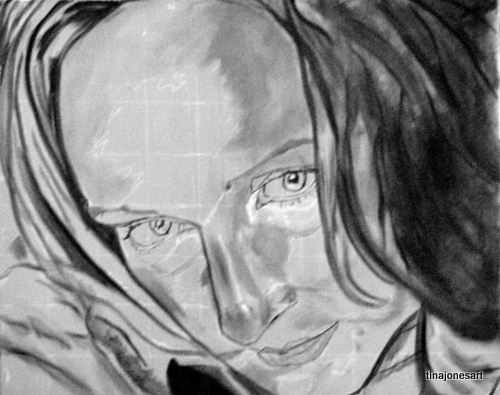
Canvas in grey (black an white gesso) Grid in White Charcoal. Laying in features in Black Acrylic.

Using Black with much medium, laying in shadows.

Shadows on the whites of the eyes and contour.

White brings out facial topography, indicates moisture in the eyes and on the lips.

"Conchi"
portrait of a friend
16x20"
Acrylic on Canvas

 Many blessings, and in this moment..... live! smiles.
tina jones

Friday, August 26, 2011

People are Funny! Ongoing Study of Neurotypicals (and their cars)

I love people! They are so funny!
I made a public appearance, meaning ofcourse I went to the store. It's my favorite place to study the species to which I, often in humor, belong. Ok, sort of, but only if I stretch it. hehe. People were very pleasant today, so all I'd have to report was that. Gratefully, the day was saved by a fellow driver.
 It's not new to me. I've been doing this for ages, and I've noted that no matter where I stop at a stop light, a driver in the next lane will pull an average distance of 2-6 feet infront of me, even it means going far over the line. Even if it means a Semi might be comming directly at them, and even it means a police car is nearby. I don't think they can help it, so I try not to get too close to the line to give them room to get ahead without endangering themselves. I think it has something to do with a curious competitive streak, I've heard about. I'll have to study that more.
   I had the advantage of being on the far left of two left turn lanes, and in the only one that continued. In other words, his lane merged into mine just after the turn. Seeing he wanted to go first, I looked over trying to get his attention to let him know it was ok. I didn't know that something might not be very pressing to him afterall, but he wouldn't look or didn't see me. With the hand that went up over his face from my side, I'm guessing he was hiding. Fun stuff!
  Ofcourse, I'd let him go first anyway, but he ran the red turn light just as adjacent lights turned yellow so he could get ahead. That might not have been necessary, had he not hidden, but it was his call.
   I sure hope he made it to the bathroom, his late appointment for a labotomy or whatever he had going on. I realize I gave up the right of way, but it's never worth fighting over, and it's far more entertaining to enjoy the show.
  What's curious to me, is from my experience, had we both approached a door, he'd have held it open for me. I always wonder which is real, but I'm sticking with the driver side of people being more authentic. It's certainly more entertaining.
tina

Monday, August 22, 2011

Being the Help We Seek: for Caregivers and Autistic People

"Perhaps they never will" Don McLean
  Those words resonate through my being ever time I talk to a parent of an Autistic child. They are trying as hard as possible to get people to listen, and in their trying...sometimes they can't hear the children with Autism. For the children who may not be as eloquent as others and for those who can't speak, it is left to us as ASD adults to share what we hear and feel, how we experience the care of those around us. In this way we can build bridges of understanding, and hopefully unite those with Autism and those who loves us. Then, perhaps progress can begin.
    Following is how I've experienced the pain of caregivers in different areas of my life, be they parents, spouses, friends, coworkers...etc.
  To the Caregivers: Though your love knows no bounds, and though you sacrifice, please know that even an ASD child may be totally mute, they hear every word you say. They see every time you hurt yourself by not getting the help you need in favor of desperately trying to help them.
  Somewhere along the line it's gotten backwards. Families are becoming depressed, sometimes neurotic and if you've seen the news lately, some have been suicidal and a few have committed homicide. Please, do not think you're exempt. I do not believe than any one can be a 24hr a day caregiver and not experience at least times of being emotionally unstable. Even therapists who work 8 hr days are required to get therapy. Though you love so deeply, please know that there is no more effective way to harm a child than to harm his mother or father or other caregiver. To love us, you must, must, must take care of you first.
  All too often the focus gets put so much on our Autism that sometimes very ill caregivers have gone past the emergency stage in needing help for themselves. You cannot give what you haven't got. You cannot help us without helping yourselves first.
   I realize there is little time. I realize this sounds like the utmost in selfishness, but if you don't take care of you, I will be reading your story in the obituaries. It may be suicide or any number of physical illnesses born of your stress, worry and sacrifice that will take you, and that would be sad for me and the many you may not realize that love and need you to take care of you.
   I know how many have turned to Autism organizations, and I know they are asking for extra dollars, when you haven't seen the site of an extra dollar in years. I know you've given your time to them, and I know they've used you to raise extra money for themselves and for research that is doing nothing to help you in this emergency moment.
    If you so much as think in terms of ending your life or someone else's, please contact a mental health professional! If you have a plan to end your life or someone else's, get someone to bring you directly to the hospital. If you are convinced you want to do it, and it is the only choice, why not wait a day and give the people a chance to come up with a better solution? Admit it may be possible that you might not know everything, you may not have seen all of the options. Let someone else try.

  To us Autistics: Society has so far not done a lot to help us. I'm with you there. Monstrous amounts of money are being raised in the name of Autism, and you're not seeing any of it effect your life. Families are trying and either getting more on your nerves daily or breaking your heart as you watch them hurting themselves. We aren't doing it to them, and we can't save them, but we can help!
   Let me recap. Society isn't helping, families can't do any more than they are doing. Looks pretty bleak, doesn't it? No.
  What we, all of society including those who love an Autistic person, and Autistic people themselves have been doing is NOT working.  I am going to flip everything and shine the light in another direction. Ready?
  You, the person with Autism may be the light at the end of the tunnel. Help is desperately needed. As an autistic person, I have things to offer. I can't do everything, but I can do some things, and some very well.  I may be the one that calls the authorities on my own family if they get nuts and start talking suicide. I may have to be the one to say, "Mom/Dad, Sister, Brother, if you don't get help, you cannot help me." I may be the one to have to walk away to save myself if they refuse to get help too.
   It may well be the Autistic people who are going to save the lives of our families and loved ones and even ourselves. Help is needed and someone has got to step up. Yes, us. Others can try to make us scapegoats for their problems, but we can refuse to take that responsibility, and see that we are not responsible for every emotion other human beings have. We can call them on the fallacy every time someone says, "You MAKE me feel.." We're not gods who'd have that kind of control. We can't make anyone do anything. We can let others have their own feelings. We can never act perfectly enough to force another person to be content. We're just not that powerful.
   This is just bare beginnings of thought, but we are going to need tools and resources to help our NT families. I suggest emergency numbers. They've got them for us, and we need them for them. This is life and death. If we know an NT person has someone that they confide in, we need that number too. We need all contact information of anyone and anything that supports them, and we need to be able to make those calls. This could be family, churches, any group or individual they (not we) find comfort in. Write a short list of information to give including the care giver's name, the address and phone number where you can be reached. Have a script! Even something like, "Jane is in trouble and needs you!" will help.
   NT's often need some kind of therapy, and they often don't get it. As we've progressed, we've watched them deteriorate. It's not our us or our Autism, but they don't know that yet. Here are a few things that may help. I went searching the net for programs specifically for them to help them get to the root of their problem and get through it to some measure of hope and happiness. (WE need them to be happy and whole!) Therapy is great and it costs money. They will have to be desperate, I mean totally desperate to even consider what I'm going to write, but if they are fortunate enough to be at the bottom there may be some hope. If they're not done fighting, I am sorry. We will have to hope they'll learn to let go soon. (They will see "fighting as a good thing" as in fighting for your care, but I am talking about a destructive fighting drive to "help" right up to and through suicide. Of course, that is never "help."
  I'm a long term member of a 12 step group, and there are many different kinds out there. I saw yesterday that these steps have been rewritten for caregivers. It may help, if they are willing.
http://qualityofliferecoverystep1.blogspot.com/2011/03/step-one-in-depth-description-and.html?showComment=1313911530212#c1876700069169191367
   Neither I nor anyone else is going to make money off of this. It is a matter of my very life to pass on what has been so freely given to me.
  Again, hope begins after they let go. Other, longer standing 12 step programs are Emotions Anonymous and Alanon Family Groups. The three I've mentioned would be the most helpful.
     Certainly, if a caregiver drinks or takes too many pills to cope, there is Alcoholics Anonymous and Narcotics Anonymous. All of these help people find a way to be content regardless of their circumstances. All use the same 12 steps, and every last one is free.
  None of these care what religion (if any) people are, how much money they have, what color they are, or if they are male or female. First names only are used, and no one even needs to know that they talked to anyone there or even went to their meetings. It's "anonymous." Frankly, I think these steps should be taught as problem solving strategies in early school, and that anyone could benefit, but they just won't work for a person, until that person has collapsed of all ideas of their own on how they are going to fix, control and manage people, places and things.

    I have to tell you, you can't force them to get help. You may have to watch them go through more pain. There is no greater force on the planet against health and sanity than the determined martyr. Let these resources be there should they reach out for help. You've seen them.
      These are just options. I don't care where people get help be they Autistic or Neurotypical.     It does not matter where a person gets help. If it works, it works! If you know of people or groups that have been supportive, share them with those you care about. Share them with other families who need help, and if you get any help, just keep paying it forward. Your very life may depend on it. Mine does, and it's working out beautifully. My aim is to build bridges of understanding, and help us see through each other's eyes. We all love, we just don't always know how.
  You're saying, "But I can't help my family! I'm the one with Autism who needs help!" I hear you..
   I heard a story a very long time ago, and I don't know the author, but it helped me.
   There were a bunch of people at a very long table. A feast as they'd never seen was laid out and they were starving. You see, they had no elbows. They picked up the food, and try as they might they could not get it to their mouths to feed themselves.
   The same table was laid out in another room, and all of the people there had no elbows either. In this room, however everyone was eating, and they were happy. Each person picked up the food and instead of trying to feed themselves, they fed another.
   Everyone needs help sometimes, and sometimes we get to be the one who gives it.
tina jones

Friday, August 19, 2011

Public Appearance: Hair 101

 These are the times I enter the world of the not always typical, neurotypicals or those who are not Autistic. These recounts of my encounters are for amusement purposes. For those who can, enjoy the links in blue. You may need to click the "back" button on your browser to return here.

  I love venturing to thrift shops, and finding odd items. At times, however I'm the odd item someone's looking for. I was inspecting a most interesting bow curve on an assembly of wood and string with no purpose other than to study the beauty of the curve. In my own world and pleasantly so, I heard a man's cheerful voice say, "That just may be a keeper." I said I didn't know what it was, and I turned it over trying to decipher the French on the back. He said, "Ah, it's a fire starter," and at that point I saw the pictorial instructions on the back, and laughed slightly for not realizing the pictures were there.
   Slight laughs do strange things to some men. His voice changed, "Mmm...I just love strawberry blonde hair," into something reminiscent of Barry White's "Can't Get Enough of Your Love Baby."
  I turned toward the sound only to find him reaching (no really) reaching for my hair! I leaned a step back gently (like any cobra would), and gave him by best, "What are you thinking?!!" stare with attendant, "Do you realize you are attempting to TOUCH me?!!!"  He pulled back his hand such as one might if fingers had been bitten off.
   I liked that part, until I noticed the plastic temporary hospital band on his wrist. His face, though not green was a lack of pink closer to chalk yellow than blue. He was walking around, apparently not in pain, trying to feel my hair, and perhaps still medicated. I try to be gentle in these situations, not that keeping or stealing a hospital bracelet is going to have much of an effect on me.
  I'm not one to have any fear of dead silences and often enjoy them, but seeing his trance, I figured I must have been inadvertently backlit. I don't know how that can happen in fluorescent lighting, but it occurs more often that one might expect..or so it seems.  I thought to speak, "My mother gave it to me." I feined a smile. At that time, his voice turned to a soprano giggle. and he said, "Oh yeah! Your mother must have given it to you," oddly, since I'd just said that. He turned quickly, and screwed up his face as he was turning away in a harrumph that sounded like, Bon Jovi's, "You Give Love a Bad Name."
   I hope he was no further wounded, and that he made it safely home. What I learned: On the right drugs, hair can make people really friendly. Yikes!
tina jones

Tuesday, August 16, 2011

The Decision to Be Who I Am

If at first you don't succeed, it's likely the Universe had a better plan for you.  At least that's my experience. I'm grateful for the ideas that didn't turn out, the dreams that didn't come true. These made way for other things that my imagination is simply not big enough to have thought up.
  Very early in school, the class was asked, "What do you want to be when you grow up?" It must have been around 1970 or 71. My family was, perhaps a little further (or a lot) behind, because it had not occured ot me, given what I saw, that I would "be" anything other than a wife and a mom one day. That was my basic training. Though school taught me there were other options, home life contiued to raise a bride, a mom and a servant/leader/protector/entertainer of family. I still consider it a dignified and difficult job, one that I didn't always fare well at, infact.
   The question shook my foundation. I was born or raised somewhere in the cultural flip between "Lib" of The Waltons and Mary Tyler Moore's office antics. I thought Lib was tougher, so I liked her better, but Mary was funny.  Scanning my personal knowledge of what women "did," outside of my family, there were things like the electrician's wife, and the preacher's wife, both positions of which seemed to require the wearing of light blue. I never could take to baby blue, so those were out. There were teachers, but they always wore seasonal vests it seemed with leaves on them for autumn and snowmen later or bunnies. It seemed too fluffy and bulky. Red! I liked red! I liked alot of colors, but red was the end-all in color. I mean if you want to be a color, you can try, but until you make it to red, you're just practicing. That was the thinking anyway. I came up with the answer!
  "I want to be a fireman!"
    The entire class burst into a roar of laughter, and while I was trying to figure out what I did that was funny (I wasn't smart enough to be embarassed.) the teacher looked at me with an, "Isn't that adorable?" pitiful sort of look. In short order, I was informed that my choices were, "Teacher, Nurse or Stay at home Mom."  I'm not sure if anyone told me, or if that was the limit of my imagination.That narrowed things down some.
   I became a bar tender. I became many things. I tried the nurse part, the somebody's wife part, and none of those panned out, despite my early training as boo boo kisser and egg salad enchantress. The only vocation I ever stuck to was the Mom part, and I'm still enjoying that. Retirement doesn't happen, but the dividends keep rolling in. grins.
   After a very long time, and all of this *being* different things, I found out that I was something. Decades of playing with crayons, pencils and paint, doing portraits, scenes and animals, while trying to figure out what I wanted to "be," sorted itself out. I didn't have to "become" an artist when I grew up. I already was one. Again, "Retirement doesn't happen, but the dividends keep rolling in."
   My two best jobs in life are Mom and Artist, and with a life like that, who'd want to retire, anyway? I've got it pretty good.
   I never did make it to "fireman," but I still like red.
tina jones
Photo by me, of me, being me.
I may paint this some day.
I may make more egg salad with paprika, but either way....
Red will be involved.